
Learning to Read
Supporting your emergent reader
Kids need a variety of skills to become proficient readers. Helping your child get ready to learn to read when they are ready, around age 5-7, begins from birth. You can help build pre-reading skills by talking, singing, reading, playing, and writing every day to help your little one learn letter sounds, hear rhymes, love books, and know many words. Find information about library resources and storytimes on our Little Ones webpage.
When your child starts learning to reading, they need a combination of learning skills with decodable books and reading books they enjoy, to practice and strengthen their emerging reading skills. They will continue to develop skills until they are ready to transition from learning to read to reading to learn around 3rd or 4th grade. Scroll down to find links to activities you can do at home, library resources, programs, book lists, and more to help you help your child learn to read.

Language Comprehension
Understanding not just the single words, but also how words are arranged to form sentences and the overall meaning of the writing.
Word Recognition
The ability to identify a written word, including its meaning and how to say it.
Skilled readers need a combination of language comprehension and word recognition skills. Scroll down to find details about what library resources help you build different skills.
YDL’s Early Reader Collection
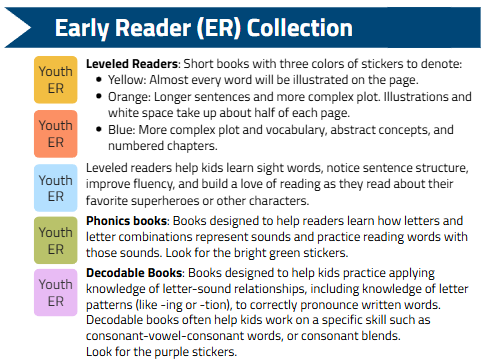
There are a wide variety of books in our Early Reader Collection. Look for the colored stickers on the spines to help you find what you need. In addition to the types of books mentioned below, you’ll find books with your child’s favorite characters or superheroes, that will help them build a love of reading.

This diagram is adapted from Scarborough’s Reading Rope, a 2001 publication. Click to learn more.
Terms to Know
PHONEMIC AWARENSS: Noticing and working with individual sounds (phonemes) in spoken words, including blending sounds into words, segmenting words into sounds, and playing with sounds in spoken words (rhymes).
FLUENCY: The ability to read with accuracy and expression to understand what is being read.
COMPREHENSION: Making sense of what is read so a reader thinks about and can actively engage with what they read.
SIGHT WORDS: Common short words that can be memorized and read without sounding them out to build fluency when reading. These include heart words that do not follow regular spelling conventions, and flash words, that can be sounded out but are often seen when reading.
Library Resources to Build Reading Skills
How to use books to build reading skills
Click the button to see details about each topic.
Connect reading to real life
Read books about starting school, going to the doctor, and other real-life experiences to increase kids’ interest in reading.
Write and tell stories
Help your child write and illustrate stories. Adults can be the scribe if needed to let kids concentrate on ideas for the story, building their understanding of story structure, which will improve reading comprehension.
Practice sounding out words
Use decodable books to steer readers away from guessing words. Attending a Read to a Library Dog program offers a fun, low-pressure time to practice.
Build background knowledge and vocabulary
Read fiction and nonfiction about topics your child is curious about. The more words your child knows, the easier it is to sound them out.
Notice how sentences work
Find books with short sentences in the Early Reader collection and in Reading Kits, to help kids move from sounding out individual words to understanding complete sentences.
Read many types of books
Read leveled readers and decodable books to master skills, read chapter books aloud as a family, read graphic novels for fun, or read Wonderbooks to follow along with the audio.
Read aloud often
Read chapter books aloud as a family, even after your child starts reading. Hearing stories builds comprehension and a love of reading. Be a reading model, too!
Strengthen alphabet and letter sound skills
Check out ABC and rhyming books you’ll find in the picture books and kids’ poetry collections to work on letter sounds, along with phonics books from Early Readers. We have plenty of Wonderbooks, audiobooks, and eAudiobooks to read aloud to kids, too.
Recognizing words by sight
Using leveled readers with short rhyming words or repetitive sentence structure helps kids begin to know some words without sounding them out.
Activities to do at home
Reading Rockets has grade level activities to build each of these reading skills.